
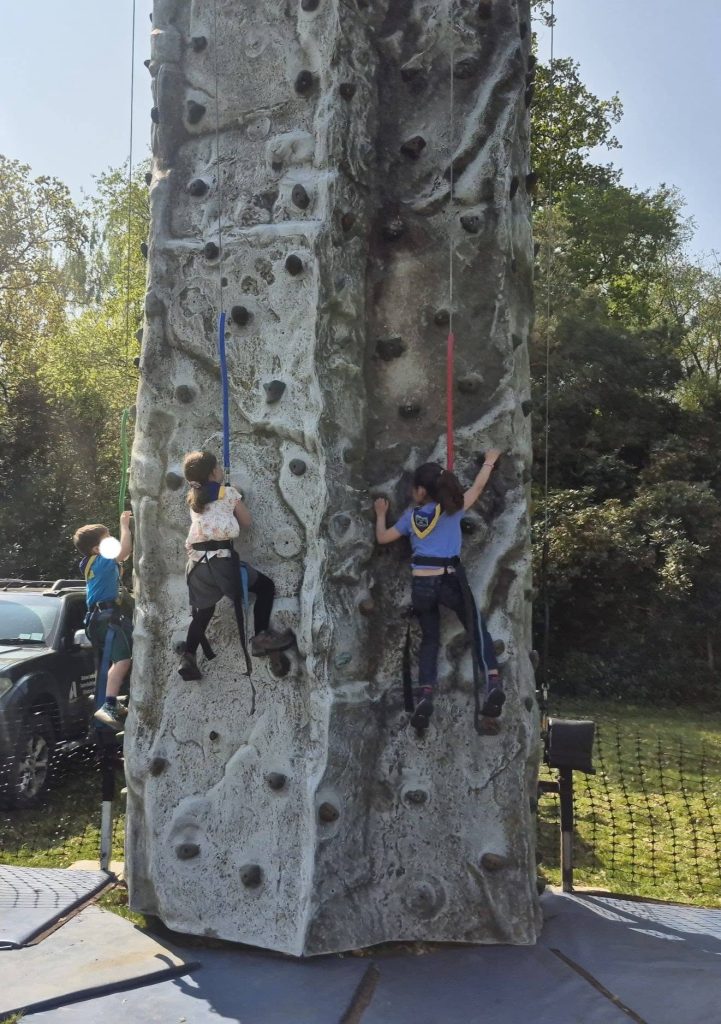
Scouting in Stowmarket goes back to 1909, just a year after Robert Baden-Powell started the movement. More than a century later the district has eight groups across Mid Suffolk and more than 700 young people, still camping, hiking and gathering round the campfire at Haughley Park.
- 1909The first Stowmarket troop
- 1910Our district warrant
- 8Scout groups today
- 708Young people in 2026
At a glance
- 1908Robert Baden-Powell publishes Scouting for Boys, and Scout troops spring up all over the country.
- 1909The 1st Stowmarket Scout Troop is formed, meeting at Mr W A Wright’s bakery in Bridge Street.
- February 1910Baden-Powell inspects Suffolk’s Scouts at Ipswich, including troops from Stowmarket and Needham Market.
- 1910A Boy Scouts’ Association is formed at Stowmarket in April, the district receives its warrant from Baden-Powell, and the Scouts move into the former Red Lion on Tavern Street.
- 1919The 1st Stowmarket Troop camps at Finborough Park at Easter and spends a week under canvas at Ufford Park in the summer.
- 1924Fifty-nine Scouts from the Stowmarket Association camp at the Imperial Jamboree at Wembley, alongside 13,000 others.
- 1926More than a hundred Scouts from Stowmarket and district hold a Whitsun camp at Haughley Park, the earliest Scout camp there that we know of.
- 1932Local solicitor John Manning Prentice buys the Milton Road site for £100 and holds it in trust for the 1st Stowmarket Scouts.
- 1935Suffolk’s County Commissioner, Vice-Admiral W. D. Paton, opens the new headquarters of the 1st Stowmarket Group in Milton Road.
- 1941As part of the war effort, 27 tons of waste paper are sorted and baled at the 1st Stowmarket Scouts’ headquarters.
- 1947Stowmarket Scouts are among the first on the scene at the fire at the Stramit Boards factory, and are thanked by the Fire Force Commander.
- 1951The Milton Road site is given to the Scout Group. District Commissioner John Milner is one of its new trustees.
- 19541st Combs opens its new headquarters, after several years of planning and fundraising.
- 1958Some 220 Wolf Cubs from the Bury St Edmunds, Sudbury and Stowmarket districts gather at Haughley Park for a county area rally.
- 1960sHaughley Park hosts the Suffolk County Shield camping competition, with patrols from troops all over the county.
- 1973The Stowmarket Scout Show celebrates its silver jubilee.
- 1982Haughley Park hosts the Suffolk County Scout Camp.
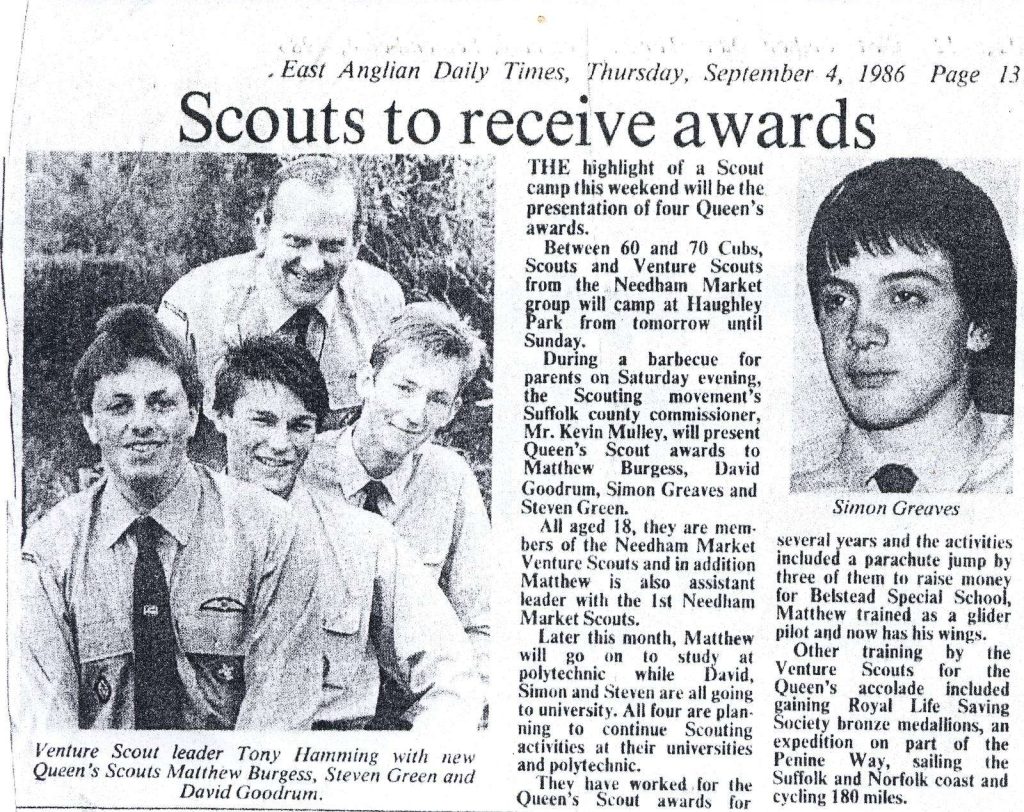
- 1986Around 60 to 70 Needham Market Cubs, Scouts and Venture Scouts camp at Haughley Park, where four Venture Scouts receive the Queen’s Scout Award.
- 20091st and 3rd Stowmarket join together as one group.
- 2010The district celebrates a hundred years of Scouting.
- 2012–13The Milton Road headquarters is reconfigured and refurbished to give the merged group modern facilities.
- 2021Beaver colonies compete for a new district challenge shield, first won by 1st & 3rd Stowmarket.
- 2022The largest Frostbite Camp ever: 98 Scouts, 17 Explorers and 35 leaders. Leviathans Explorer Unit forms at Wetherden & Haughley.
- 2026Needham Market’s new Scout HQ opens, and district membership reaches 708 young people.
- 2027Six young people from the district head to Poland for the World Scout Jamboree.
How it all began
The 1st Stowmarket Scout Troop came into being in 1909. Its first Scoutmasters were Mr W A Wright, a baker, and Mr Hugh Turner, who ran a grocery in the Market Place, and the troop’s first meeting place was Mr Wright’s bakery in Bridge Street.
It grew quickly. With seventy boys on the roll the troop soon needed more room, and in 1910 the former Red Lion pub on Tavern Street was adapted as its new headquarters. The Scouts had their own bugle and drum band, which played at important occasions in the town.
Scouting spread fast. In August 1909 the Boy Scouts’ Court of Honour, meeting at the Ipswich YMCA, resolved to form a district council covering Stowmarket, Needham Market and other towns, and on 15 February 1910 Baden-Powell himself inspected Suffolk’s Scouts at Ipswich, among them the Stowmarket troop and two troops from Needham Market. That August the Stowmarket and Needham Market troops gathered at a camp in Finborough Park, where they gave displays of flag signalling and first aid.
In April 1910 a Boy Scouts’ Association was formed at a meeting in Stowmarket, where speakers hoped the new Scouts and the town’s long-established Boys’ Brigade would work together rather than compete for boys. The same year, Baden-Powell granted the warrant for Stowmarket District, and by that summer a local event offered contests for “teams of Scouts living within a ten-mile radius of Stowmarket”, while the Boy Scouts of Eye and district were already up and running. When the district held its tenth annual meeting in January 1920, it was chaired by District Commissioner Charles Pettiward. A hundred years after it began, in 2010, the district celebrated its centenary.
Camps, bands and concert parties
Local newspapers followed the early Scouts closely. The Suffolk Chronicle, Bury Free Press and East Anglian Daily Times report the 1st Stowmarket Troop camping in the parks of country houses around Suffolk: Finborough Park at Easter 1919, where they were inspected by Brigadier-General Lord Playfair, Ufford Park that summer, Thornham Hall in 1922 and Redgrave Hall in 1923.
The Stowmarket Scouts’ bugle and drum band, led by District Scoutmaster Hugh Turner, played at the unveiling of war memorials across the district after the First World War, including Haughley, Shelland and Bacton in 1920. At Bacton the 1st Stowmarket Scouts paraded alongside the 1st Bacton Troop. In April 1920 around 250 Scouts and Wolf Cubs held a church parade and inspection in Stowmarket, and in 1924 fifty-nine Scouts from the Stowmarket Association joined 13,000 others at the Imperial Jamboree at Wembley.
In the 1920s the 1st Stowmarket Scout Concert Party and Pierrot Troupe toured the villages, giving shows at Coddenham, Wetherden, Stowupland and Haughley, where in 1926 they raised money for the new 1st Haughley Troop. By the 1930s there was a 2nd Stowmarket Group with its own Rover Scouts, and Scouts from 1st Mendlesham joined the town’s St George’s Day celebration in 1935.
A home on Milton Road
In 1932 John Manning Prentice, a Stowmarket solicitor, bought the site on Milton Road from the Constitutional Club for £100 and held it in trust for the 1st Stowmarket Scout Group. Part of the building had been leased to a firm of vehicle repairers. Mr Prentice died in 1943, and in 1951 the site was given to the group, with new trustees including John Milner, then District Commissioner. Mr Milner also helped to set up 3rd Stowmarket at the Methodist Church. Suffolk Archives holds the architects’ survey of the Milton Road premises, drawn up for the Boy Scouts’ Association in October 1949, and a notice for a 1st Stowmarket Scouts jumble sale in March 1950.
Newspapers report that on a Saturday afternoon in May 1935 Vice-Admiral W. D. Paton, Suffolk’s County Commissioner, declared open the new headquarters of the 1st Stowmarket Group in Milton Road; the group’s own history dates the building’s official opening as its headquarters to 1955, after the site had been handed over. In the Second World War the building became a salvage centre, where 27 tons of waste paper were sorted and baled for the council by 1941. Six patrol dens were added to the outer hall, and the building served the group for more than fifty years. In September 2009 1st and 3rd Stowmarket joined together, and in 2012–13 the building was reconfigured and refurbished to give the merged group modern facilities. Find out more on the 1st & 3rd Stowmarket website.
Shows, service and growing up
After the war, Stowmarket Scouts became known for their annual Scout Show at the Church Hall, with titles like Happy Venture (1952), Young in Heart (1953) and Take a Tonic (1955). For years the music was composed by John Milner, who was honoured for his services to Scouting in 1959, and the show was featured by the BBC. It celebrated its silver jubilee in 1973.
Scouts also served the town. In May 1947 they were among the first on the scene at the fire at the Stramit Boards factory, manning the telephone and helping the fire service, and they sold the official programmes for the Coronation in 1953. New headquarters followed across the district: 1st Combs opened theirs in 1954, and the 1st Wetherden and Haughley Group held carols by candlelight in the Haughley Scout Hall in 1956. In 1956 the district also welcomed a new group when Old Buckenham Hall School moved to Brettenham.
Haughley Park
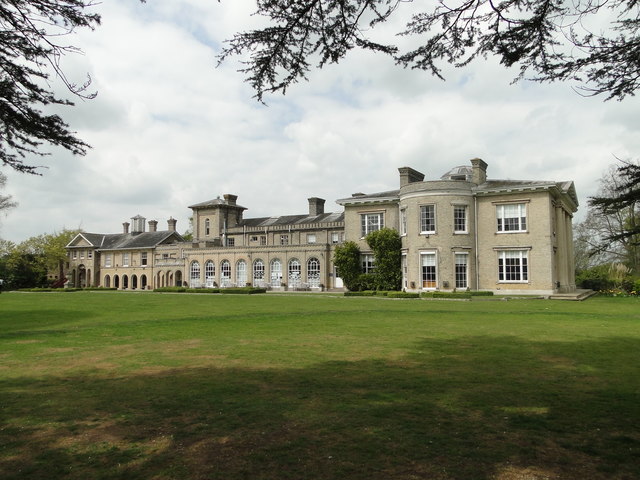
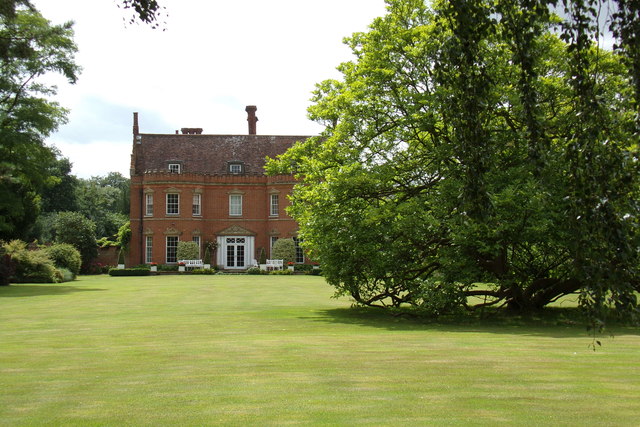
For generations of young people in Mid Suffolk, camp means Haughley Park. The park surrounds a Grade I listed Jacobean house built around 1620 for the Sulyard family, and the Williams family have owned the estate since the 1950s. Scouts camp there with the kind permission of the landowner.
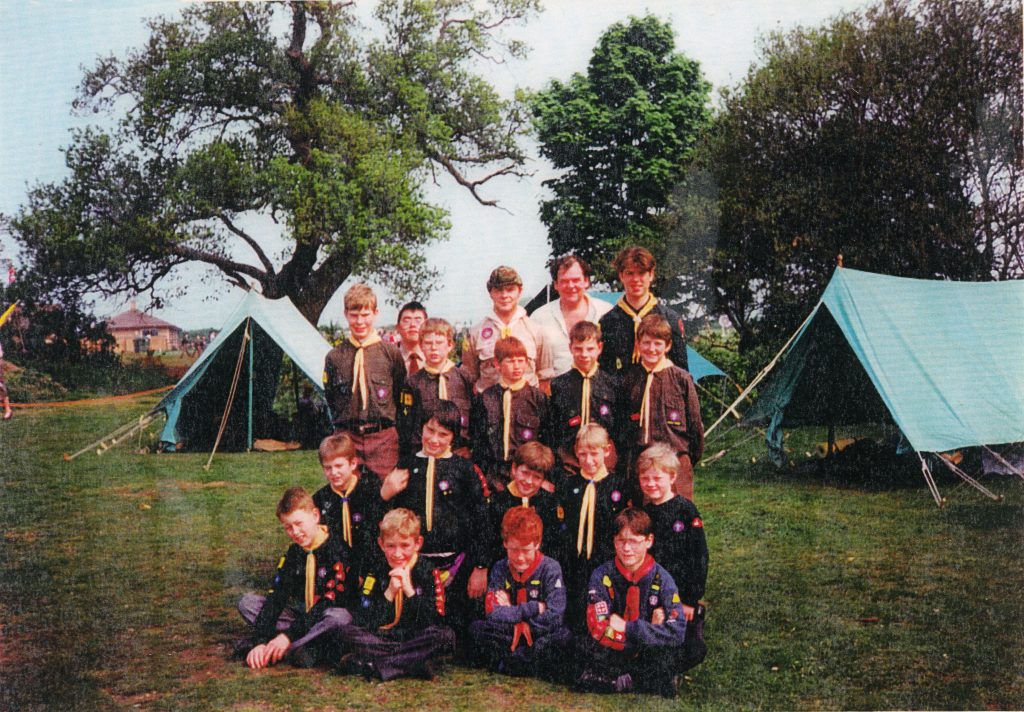
Scouts have been camping in the park for a century. At Whitsun 1926 more than a hundred Scouts from Stowmarket and district held a camp there, in 1927 new colours were presented to the 1st Wetherden and 1st Coddenham Troops in the park, and in 1933 the Suffolk Association of Boy Scouts held a County Rover Moot there by permission of the then owner, Turner Henderson. In the 1950s the 1st Wetherden and Haughley Troop held its outdoor meetings in the park, and in 1958 some 220 Wolf Cubs gathered there for a county area rally.
From the 1950s, with the kind permission of the Williams family, the park was also used for county events. Through the 1960s it hosted the Suffolk County Shield camping competition, with 32 troops taking part in one year; in 1970 Stowmarket district held a father and son camp there and a rally for 250 Cubs; and in June 1982 it hosted the whole county, when Lowestoft Scouts were photographed with a pennant reading ‘County Camp 1982 Haughley Park’. In September 1986 between 60 and 70 Needham Market Cubs, Scouts and Venture Scouts camped there, and Suffolk’s County Commissioner presented the Queen’s Scout Award to four of their Venture Scouts.
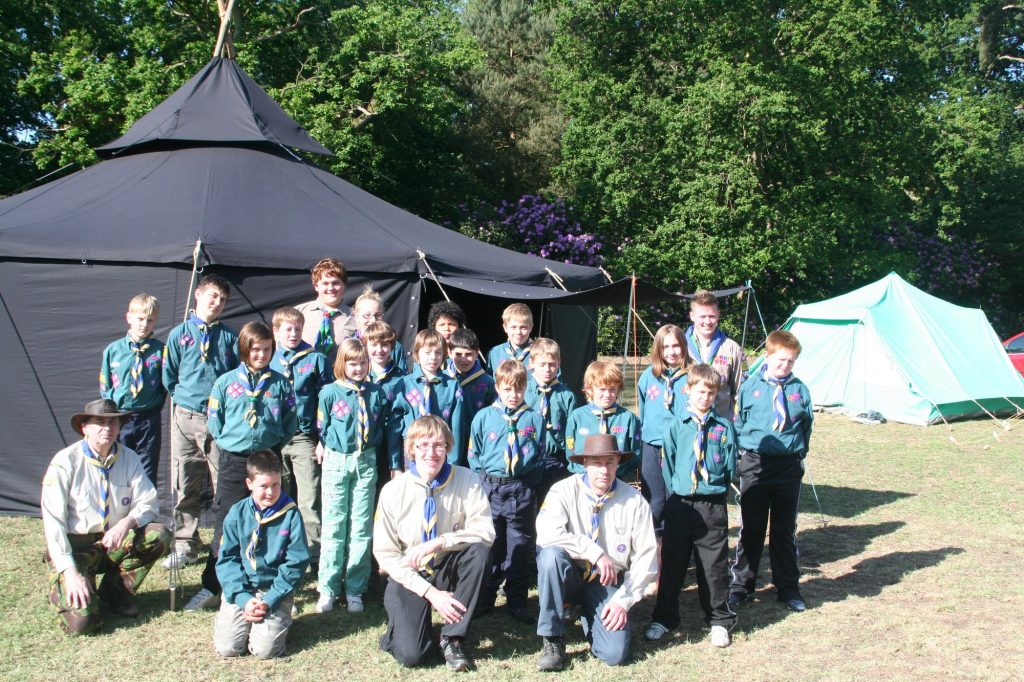
For many years the park was used by Scouts from across Suffolk, but it is now kept for Stowmarket District. The district looks after Boundary Cabin, and groups book the Paddock, the woodland and the campfire circles, including the main circle known as the Bomb Hole, laid out like an amphitheatre, for camps, evenings and district events. Find out about Haughley Park.
District traditions
Some events have been part of the district calendar for years, and bring groups from every corner of the district together.
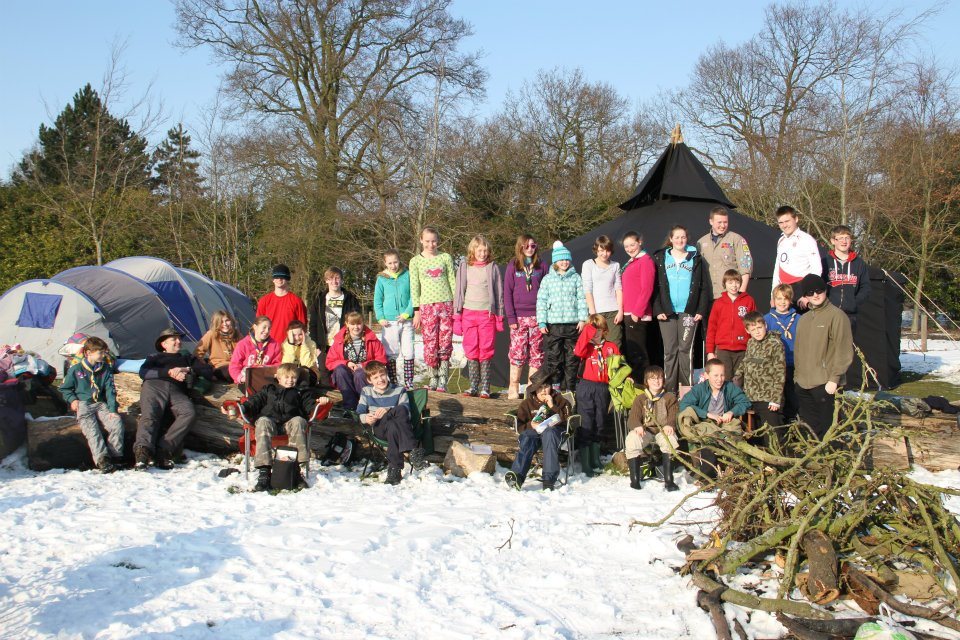
Frostbite Camp
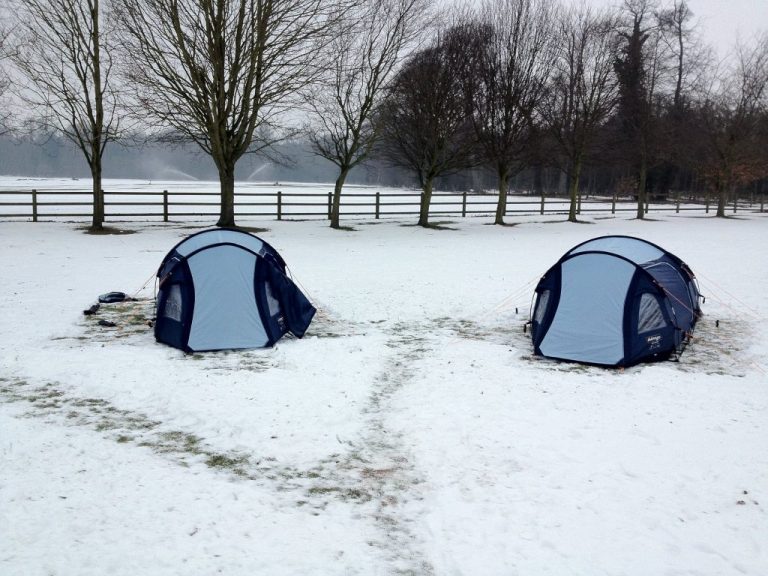
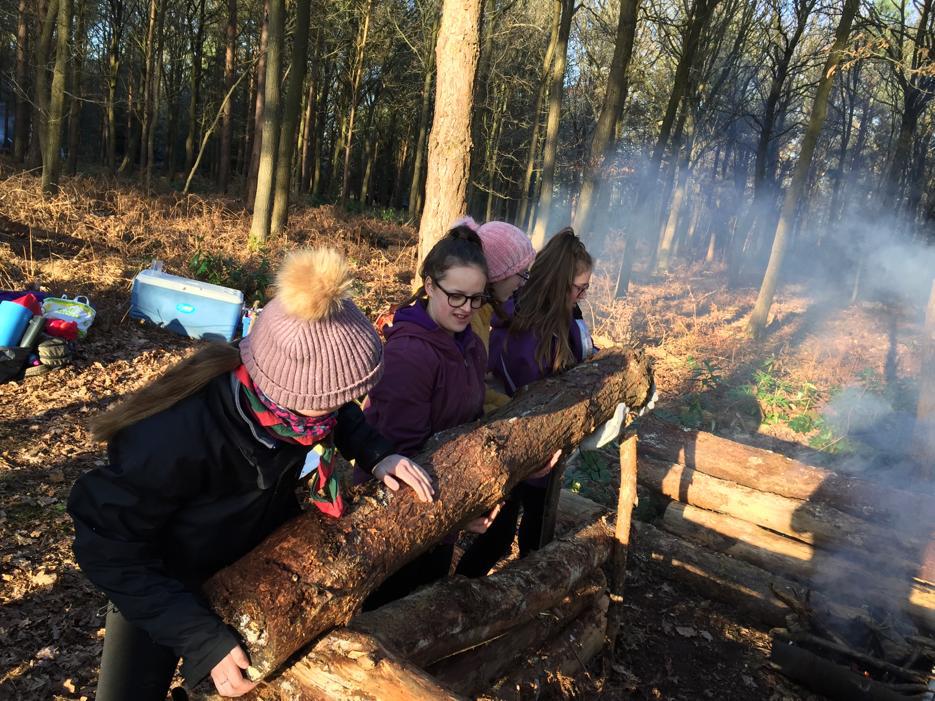
Every winter, Scouts and Explorers brave the cold for a weekend at Haughley Park. In February 2022, 98 Scouts, 17 Explorers and 35 leaders made it the largest Frostbite Camp ever, and most recently over 100 Scouts and Explorers cooked venison burgers over open fires.
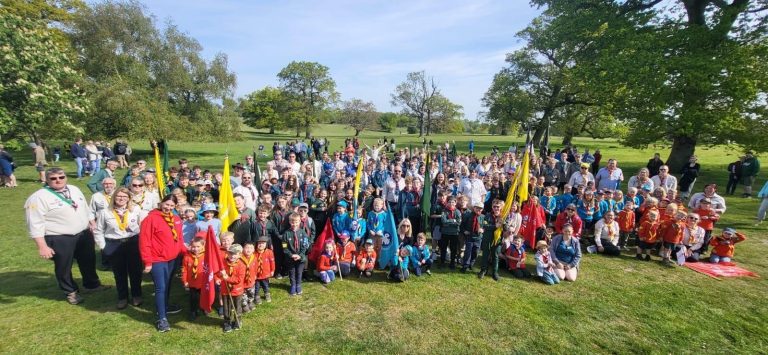
St George’s Day
Around 300 young people and volunteers parade from the Paddock to the cabin at Haughley Park, renew their Scout Promise and receive awards, then try archery, tomahawk throwing and the climbing wall before a campfire.
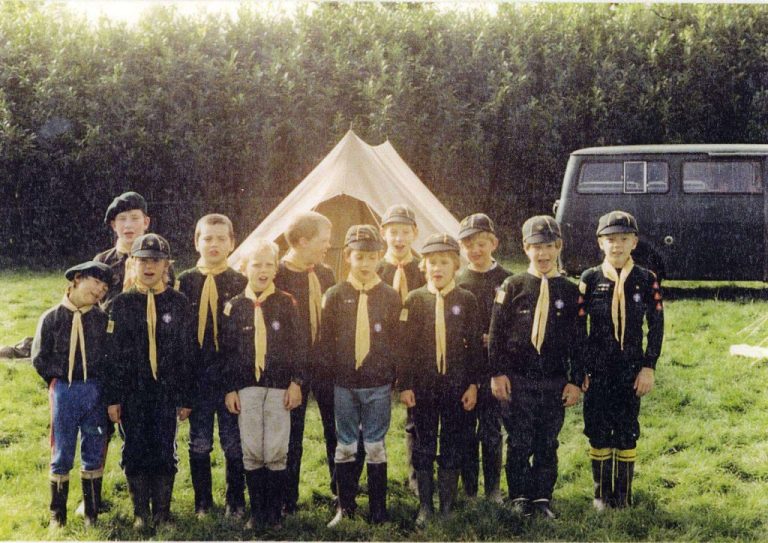
District camps
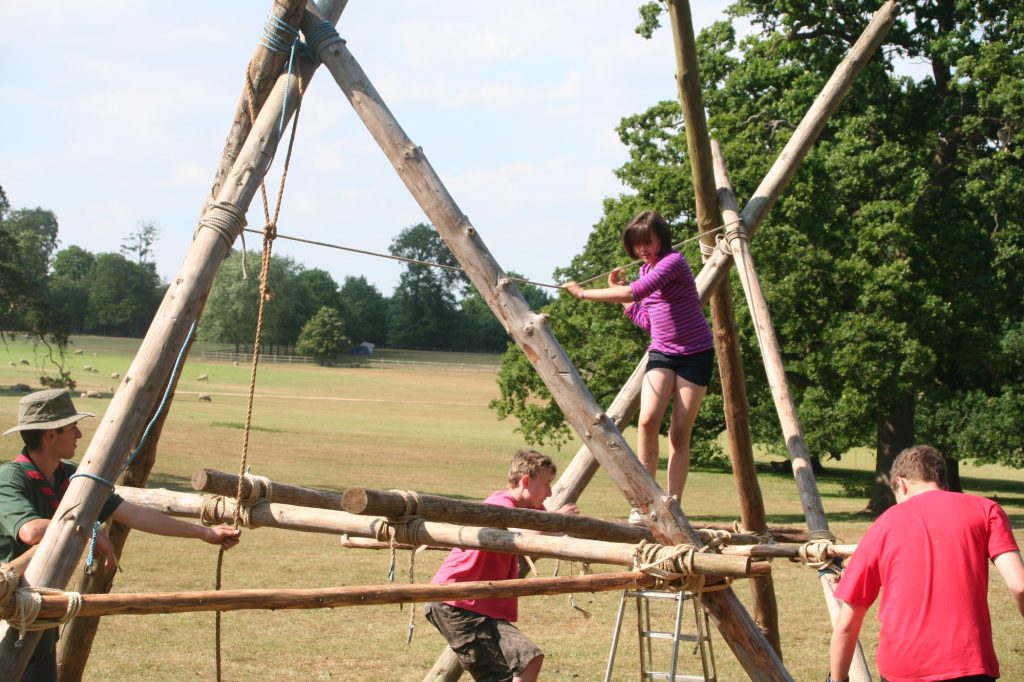
District camps have brought groups together for decades, from the camp in 1994 to pioneering towers in 2011 and today’s Beaver Camp at Bradfield Park and Scout summer camp at Hallowtree.
- District Light HikeTeams of Scouts navigate a long route across the Suffolk countryside. In the last hike, 96 Scouts in 16 self-sufficient teams walked from Lindsey Tye to Boxford Spinney.
- Mud RunA 6.5 kilometre course with 24 obstacles, which draws competitors from inside and outside the district.
- Carol ServiceEvery December the district meets at St Peter’s and St Mary’s Church in Stowmarket, with the collection going to the local foodbank.
Groups across the district
Each of our groups has its own story, and old newspapers show how early Scouting reached the towns and villages of Mid Suffolk.
- 1st & 3rd StowmarketThe 1st Stowmarket Troop dates from 1909. A 2nd Stowmarket Group, with its own Rover Scouts, was running by the 1930s, and 3rd Stowmarket was founded at the Methodist Church with help from District Commissioner John Milner. 1st and 3rd joined together in 2009.
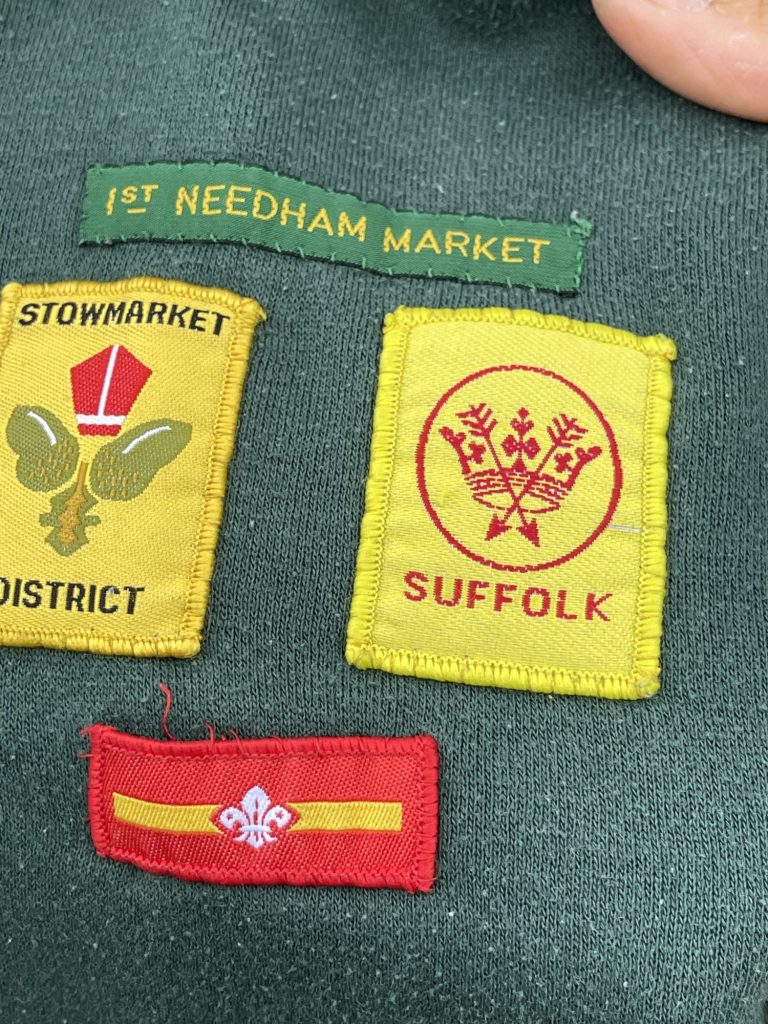
- 1st Needham MarketScouts were active in Needham Market by March 1909, when “the Boy Scouts of Needham Market” sent a wreath to a funeral, and the 1st Needham Market Troop was meeting at the Temperance Hall by 1910. Read the group’s own history; its brand-new Scout HQ opened in February 2026.
- 1st EyeThe movement was “not long established in the Eye district” when its Scouts went to their first camp in August 1910. That October a harvest festival parade at Eye included Scouts from Eye, Hoxne, Thrandeston, Occold and Thorndon. Eye had Air Scouts in the 1950s, and today has a new headquarters on Wellington Road, built after raising almost £130,000.
- 1st Wetherden & HaughleyHaughley had Scouts by 1913, when “the Stow and Haughley Scouts” ran their own stall at a fete in Finborough, and in 1914 Hugh Turner was Scoutmaster of the 1st Haughley Troop. New colours were presented to the 1st Wetherden Troop at Haughley Park in 1927, and by the 1950s the combined 1st Wetherden and Haughley Troop held its outdoor meetings in the park and was raising money for its own Scout hall.
- 1st MendleshamBy 1930 Mendlesham had a troop of Scouts and Wolf Cubs, and in 1932 it was led by Miss I. Juby as Scoutmaster and Miss K. Juby as Assistant Scoutmaster, with Mrs Pizzy as Cubmistress. Their annual concerts filled the village hall. The group is now planning a new log-cabin style Scout hut on its old site.
- 1st CombsIn 1951 two 14-year-old Patrol Seconds of the 1st Combs Troop were awarded the Scout Gilt Cross for rescuing a three-year-old child who had fallen into flood water. The group opened its new headquarters in 1954, and its duck race at Combs Ford has run for more than thirty years.
- 1st DebenhamDebenham Scouts were making “remarkable progress” in 1911, helped by Mr Chevallier, who was also largely responsible for starting a troop at Aspall. In the 1930s the 1st Debenham Troop paraded with the village’s Guides, Cubs and Brownies; in the 1950s Debenham belonged to the Mid-Suffolk Local Association of Scouts.
- 1st ElmswellThe 1st Elmswell Troop and Cub Pack paraded with newly presented colours in 1928. That season the Elmswell Scouts also fielded a football team in the local league, beating the Bacton Scouts 6–2.
- BactonThe 1st Bacton Troop was led in 1920 by a woman Scoutmaster, Grace Woodward, and held its first annual meeting in 1921. By 1938 its Scouts and Rovers had their own headquarters, and in 1952 almost 200 Scouts, Cubs and Guides paraded at Bacton. The group has since closed, and its HQ is looked after by the district.
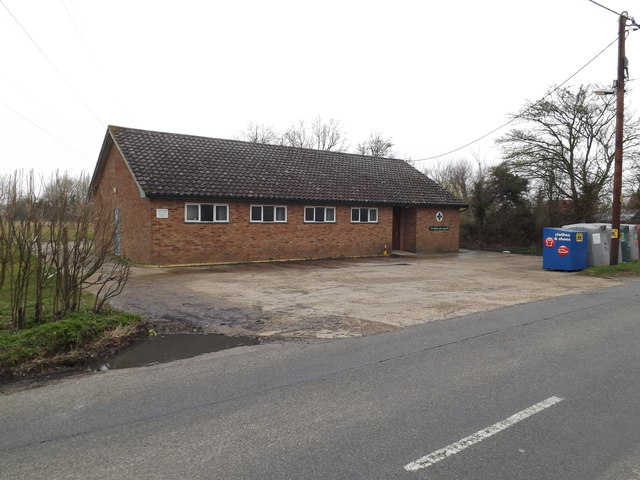
As towns and villages change, so does Scouting. The Bacton group closed in recent years, and its headquarters is now looked after by the district and used for meetings and training. Meanwhile new sections keep opening: Squirrel dreys for 4 to 6 year olds, a new Cub pack at Eye, a re-established Scout troop at Elmswell, and seven Explorer units, from Wolves at Needham Market and Cavaliers at Debenham to Leviathans at Wetherden & Haughley.
- 495 young people in 2021
- 584 in 2022
- 708 in 2026, a rise of 5.5% in a year
Explore the archives
Want to dig deeper? These records can be seen at Suffolk Archives:
- Milton Road survey, 1949Architects’ survey of the HQ premises in Milton Road for the Boy Scouts’ Association (HG500/1/527i).
- 1st Stowmarket jumble sale, 1950Ephemera from the Stowmarket parish collection, 11 March 1950 (HD2272/221/6/5).
- County Camp, 1982Lowestoft Journal scouting cuttings, 1964–1994, including County Camp at Haughley Park (1176/2/2/19/652).
- Needham memories, 1988Oral history interview recalling the first Boy Scouts in Needham Market (L401/1/590).
Many more reports, from the founding meeting in 1910 to the Scout shows of the 1970s, can be found by searching for “Stowmarket Scouts” in the British Newspaper Archive, which is free to search online; reading the full pages needs a subscription. The Scouts’ own Heritage Enquiries Service at Gilwell Park can help with early warrants and group records.
The next chapter
Every part of this story was made possible by volunteers: Scoutmasters in a bakery, trustees who saved a building, and leaders who still give up their evenings and weekends. Many of our groups have waiting lists, and the next chapter depends on more adults coming forward.
Have you got photos, badges or memories of Scouting in Stowmarket District? We’d love to add them to this page. Get in touch.
Sources: 1st & 3rd Stowmarket Scout Group, district annual reports, Suffolk Archives (HG500/1/527i, HD2272/221/6/5, 1176/2/2/19/652, L401/1/590), the British Newspaper Archive (Suffolk Chronicle, Bury Free Press, East Anglian Daily Times, Evening Star, Diss Express), Suffolk Scouts, 1st Mendlesham and 1st Combs Scout Groups, the East Anglian Daily Times and 1st Needham Market Scout Group. Archive photos courtesy of 1st Needham Market Scout Group. Photos of Haughley Park House, Finborough Hall and Bacton Scout HQ from Geograph (Geographer; Adrian S Pye; Geographer), licensed under CC BY-SA 2.0.